Loading game details...
Tetris
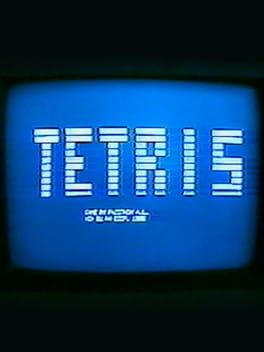
Original title: Tetris - April 4, 1985

Click to set progress
I have finished
Director:Alexey Pazhitnov
Studio:ELORG
Stars:-
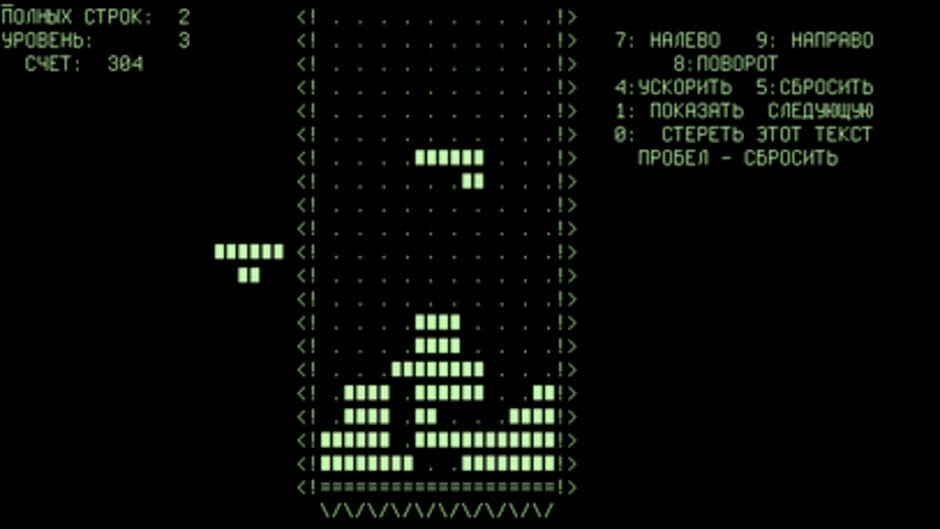
Soundtrack:The theme everyone knows is not an original composition. 'Korobeiniki' — 'The Peddlers' — is a 19th-century Russian folk song built on a narrative poem by Nikolai Nekrasov, first published in 1861, about a travelling pedlar bargaining with a girl as a metaphor for courtship. Musical settings were published from 1898 and recorded on gramophone from 1905, The original 1984 Elektronika 60 build had no music at all, no score and no levels — it was text characters on a monochrome terminal, Arrangements of Korobeiniki first attached to Tetris in Spectrum HoloByte's 1988 Apple IIGS and Macintosh ports. The version that became globally synonymous with the game is Hirokazu Tanaka's 1989 chiptune arrangement for the Game Boy, listed there as Music Type A, The Tetris Company has since taken a sound trademark on that arrangement for use in games, and has required its inclusion in every officially licensed version since 2002, Other early releases used entirely different music: the American NES version included Tchaikovsky's Dance of the Sugar Plum Fairy, and the Game Boy's other two tracks were an original Tanaka composition and a Bach minuet
Full Crew:View Full List

Game
Golden Joystick Awards − Ultimate Game of All Time
Nominee
2021
Media Gallery
 Trailer 1Main Image
 Screenshot 1
 Screenshot 2
 Screenshot 3
 Screenshot 4
 Screenshot 5
 Screenshot 6
 Screenshot 7
 Screenshot 8
 Screenshot 9
 Screenshot 10
Game Details
Story
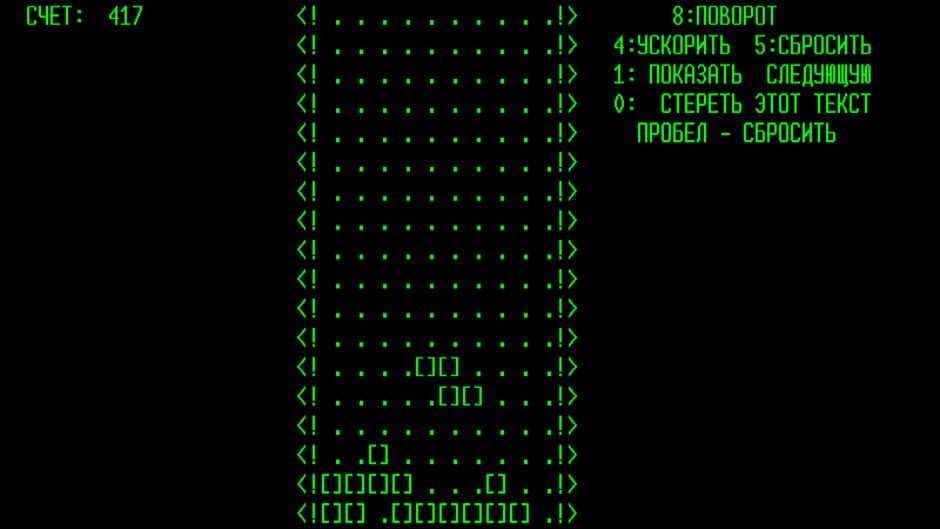
The original version of Tetris was created by Alexey Pajitnov for the Elektronika-60 computer. It was never released commercially. It was also playable on the successor DVK-1 and DVK-2 computers, although it is unknown whether that is a different version, or simply the same code running on a different computer. Minor visual differences are present, but the gameplay is the exact same.
Loading ratings...
Crew & Contributors 8

Brad Fuller
Audio & Music • Composer
Ed Bogas
Audio & Music • Composer
Alexey Pazhitnov
Direction • Game Director
Alexey Pazhitnov
Production • Producer
Time to Beat
Average Completion Times
Loading...
Did You Know?15
View all 15 facts →Awards1
Loading reviews...
Data aggregated from 3 sources: IGDB, Steam, Wikidata
Last updated: 06.08.2026
Business
BudgetReported
No commercial budget
written in spare time by a state-salaried researcher, officially justified as hardware testing
RevenueReported
520 million copies across all official versions as of 2022
though the aggregate framing is disputed, and the creator personally earned nothing from it for a decade
en.wikipedia.orgThere was no budget in any commercial sense. Alexey Pajitnov built Tetris in his spare time as a salaried researcher at the Dorodnitsyn Computing Centre of the USSR Academy of Sciences, justified internally as testing new hardware. Under Soviet rules any rights belonged to the state and the institute, not to him, and he arranged a ten-year hold with the Centre to navigate that. He earned nothing from the game for roughly a decade. The rights history that followed is genuinely tangled and worth stating in order. In 1986 Robert Stein encountered a Commodore 64 port in Budapest and telexed Moscow for rights; the noncommittal reply was treated as a licence and he began selling it on. By 1988 he had sold European rights to Mirrorsoft and US rights to Spectrum HoloByte for GBP 3,000 plus royalties, before Soviet approval was actually settled. ELORG, the Soviet software export monopoly, discovered the unauthorised sublicensing and forced a narrower contract covering computers only — by which point Atari's Tengen had already picked up arcade and disputed console rights further down the chain. In February 1989 Henk Rogers flew to Moscow uninvited, showed ELORG a Famicom cartridge that exposed the unauthorised console releases in circulation, paid over $40,000 to remedy the breach, and won the handheld rights for Nintendo. Nintendo sued; in June 1989 a US court ruled that the original contract's reference to 'computers' did not cover consoles, and Tengen's cartridges were withdrawn. The institute's hold lapsed at the end of 1995, rights reverted to Pajitnov, and in 1996 he and Rogers founded The Tetris Company — the point at which he began earning royalties, about a decade after creating the game. Rogers acquired ELORG's residual stake around 2005, forming Tetris Holding. On sales: the Game Boy version alone passed 35 million copies by 2009, and the NES version about 8 million by 2004. The often-quoted 520 million total is The Tetris Company's own self-reported aggregate across every version and platform, and the 'best-selling game ever' claim it supports is explicitly rejected by Guinness World Records, the BBC and others, who decline to aggregate separate products. Guinness does credit Tetris as the most-ported game ever, across more than 70 platforms and roughly 220 official versions.
Language Support
Language
AudioSubUI
English
✔✔✔
French
—✔✔
Italian
—✔✔
German
—✔✔
Spanish - Spain
—✔✔
Japanese
—✔✔
Korean
—✔✔
Simplified Chinese
—✔✔
Thai
—✔✔
Traditional Chinese
—✔✔
Russian
——✔
Content Rating
-
-
Game Features
Intense Violence
Steam Cloud
System Requirements
Minimum
Requires a 64:bit processor and operating system
OS:Windows 10
CPU:Intel i3-4340
RAM:4 GB RAM
GPU:NVIDIA GTX 750 Ti equivalent or greater
DirectX:Version 11
Storage:5 GB available space
VR Support:SteamVR or Oculus PC
Additional Notes:Minimum specs for non-VR mode
Available On

Community & Media
Data aggregated from 3 sources: IGDB, Steam, Wikidata
Last updated: 06.08.2026